Claude AI technology distinguishes itself in 2025 through several key aspects. Developed by Anthropic, Claude uses a unique method called Constitutional AI, which guides its learning with ethical principles instead of just human feedback. This makes it safer and more reliable. Notably, it has advanced multimodal capabilities, allowing for improved natural language processing and reasoning with a context window of 200,000 tokens. Also impressive is its ability to create shareable visualizations or artifacts from raw data. Compared to competitors like ChatGPT, Claude excels in structured reasoning and safety-focused outputs while offering various pricing plans that appeal to both casual users and businesses alike.
Table of Contents
- Development and Company Background of Claude AI
- Unique Features of Claude AI in 2025
- Performance and Usability Highlights
- How Claude Compares to ChatGPT
- Future Directions for Claude AI
- Pricing and Access Options for Users
- Frequently Asked Questions
1. Development and Company Background of Claude AI
Claude AI is the brainchild of Anthropic, a company founded in 2021 by Dario and Daniela Amodei, who previously spearheaded initiatives at OpenAI. Anthropic was established with a clear mission: to create AI systems that prioritize safety and ethical considerations. This commitment to responsible AI development is at the core of Claude’s design, which emphasizes interpretability and user trust. The name “Claude” pays homage to Claude Shannon, a pioneer in information theory, reflecting the company’s dedication to advancing the field of AI responsibly. Anthropic has attracted significant funding, enabling it to assemble a team of skilled researchers and engineers focused on AI safety. Their approach includes promoting collaboration with other organizations to further the cause of ethical AI, setting new standards in the industry.
2. Unique Features of Claude AI in 2025

Claude AI distinguishes itself in 2025 with a range of unique features that enhance user interaction and problem-solving. One of its standout capabilities is its multimodal processing, which allows it to effectively handle text, images, and code. This flexibility enables users to engage with the AI in various ways, making it suitable for diverse applications. Additionally, Claude boasts an impressive context window of 200,000 tokens, facilitating extensive dialogues without losing track of the conversation’s flow.
Another noteworthy feature is Claude’s ability to create interactive visualizations, known as artifacts. These artifacts transform raw data into structured, shareable formats, enhancing user engagement and comprehension. For example, a user can input complex data, and Claude can generate an interactive chart that visually represents the information, making it easier to understand and share.
Claude’s extended reasoning abilities further set it apart, allowing it to tackle intricate problems more efficiently. This capability is particularly beneficial in scenarios requiring deep analysis or creative solutions. The model also emphasizes ethical decision-making, guided by principles from its unique training method, Constitutional AI. This focus on ethics reduces the risk of harmful outputs, making it a reliable choice for businesses.
Moreover, Claude is designed to learn from a wide range of datasets, enhancing its adaptability to various user needs. It not only provides outputs but also offers detailed explanations, helping users grasp the logic behind its answers. The advanced context retention feature ensures that conversations remain coherent over time, allowing for more natural interactions. Lastly, the user interface is intuitive, catering to both casual users and professionals, which further contributes to its appeal.
- Claude AI offers multimodal capabilities, able to process text, images, and code effectively.
- It has a context window of 200,000 tokens, allowing it to handle extensive dialogues.
- The model can create interactive visualizations called artifacts, enhancing user engagement.
- Extended reasoning abilities enable Claude to tackle complex problems more efficiently.
- Claude’s training involves ethical principles that guide its decision-making processes.
- The AI is designed to learn from diverse datasets, improving its adaptability.
- Claude can provide detailed explanations for its outputs, aiding user comprehension.
- It features advanced context retention, making conversations more coherent over time.
- Claude’s user interface is intuitive, catering to both casual and professional users.
- The model is continuously updated with new features based on user feedback.
3. Performance and Usability Highlights
 Credits: davydovconsulting.com
Claude AI is recognized for its strong safety measures, which help to significantly reduce the risk of harmful outputs. This focus on ethical design appeals to users who prioritize safety in their AI interactions. In terms of performance, Claude excels particularly in code generation, where it produces high-quality, readable code along with detailed explanations of its logic, making it a valuable tool for developers looking to enhance their coding skills. User satisfaction remains high, with ratings often exceeding 80 out of 100, indicating that people find Claude effective and easy to use.
The usability of Claude spans across multiple industries, such as education and healthcare, where it effectively manages diverse tasks simultaneously without compromising performance. This makes it particularly well-suited for collaborative environments, where teams can leverage its capabilities to work together efficiently. Claude also adapts its responses based on user preferences and past interactions, creating a more personalized experience. The AI’s speed and accuracy in generating responses are consistently highlighted as key strengths, ensuring that users receive timely and relevant information. Furthermore, Claude is designed to learn continuously from user interactions, which contributes to its ongoing improvement and effectiveness in various applications.
4. How Claude Compares to ChatGPT
 Credits: hustleinspireshustle.com
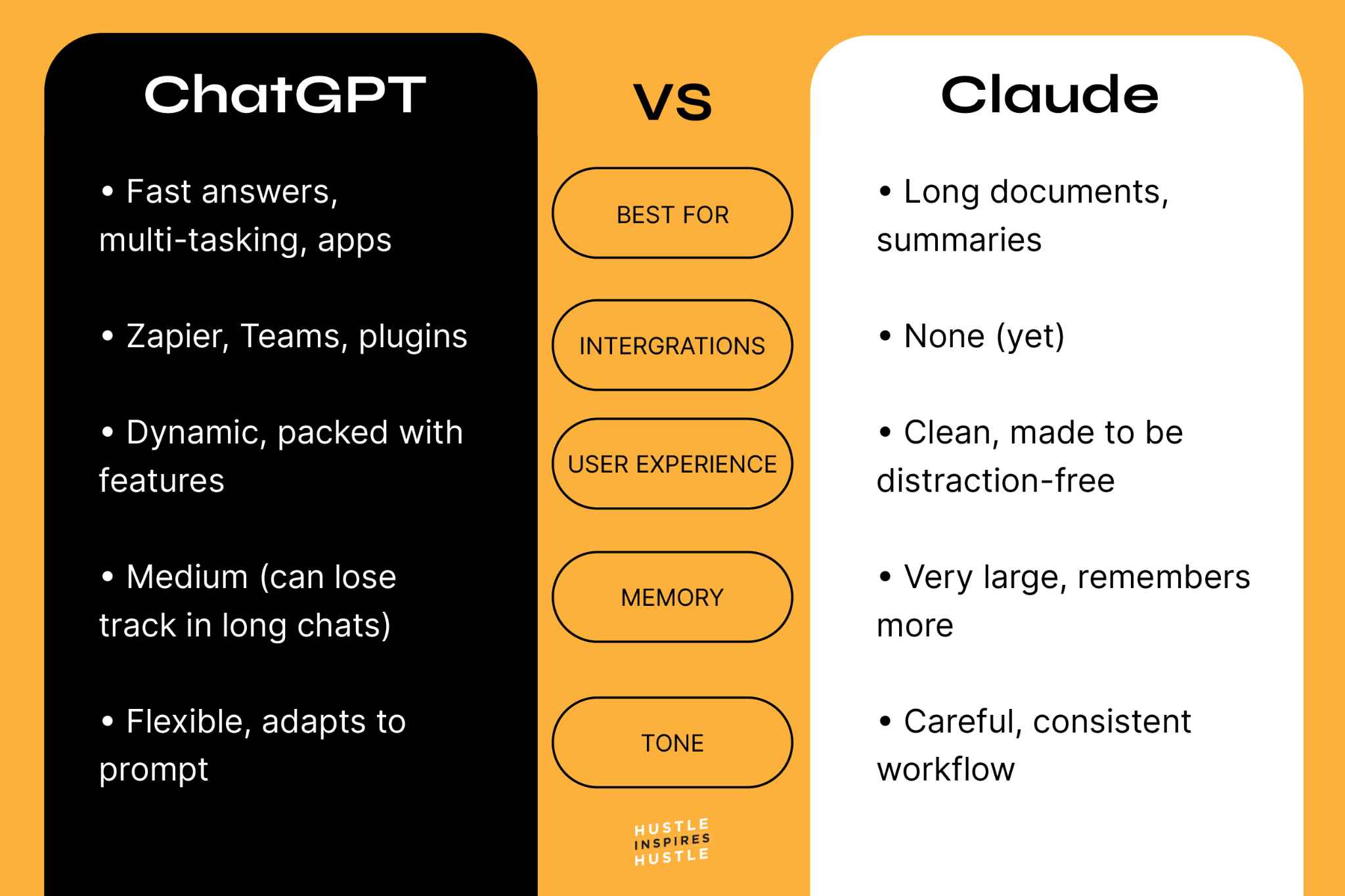
Claude AI and ChatGPT each offer unique strengths, catering to different user needs. Claude focuses more on structured reasoning, making it particularly useful for tasks requiring logical analysis. In contrast, ChatGPT takes a broader approach, excelling in extensive automation across various applications. User satisfaction ratings suggest that Claude is preferred for coding tasks, where it provides accurate code and detailed explanations, enhancing the developer’s understanding. Claude’s ability to handle long contexts is often regarded as superior, allowing for more coherent and continuous conversations. While ChatGPT benefits from numerous third-party integrations, Claude prioritizes user trust and safety, ensuring that outputs are ethical and less likely to cause harm. Performance benchmarks reveal that Claude shines in complex problem-solving scenarios, reinforcing its position as a reliable assistant. Ultimately, the choice between Claude and ChatGPT depends on the specific requirements of the user, as both models serve distinct purposes in the AI landscape.
5. Future Directions for Claude AI
Anthropic is committed to enhancing Claude’s ethical frameworks in upcoming versions, ensuring that the model continues to prioritize safety and reliability. Future updates are expected to expand Claude’s multimodal capabilities, allowing it to process and understand diverse types of data even more effectively. User feedback will play a crucial role in these improvements, as Anthropic aims to create a system that evolves based on real-world experiences and requirements.
As Claude develops, it is likely to tackle increasingly complex tasks, broadening its scope of applications across various industries. To enhance its functionality, Anthropic is exploring partnerships that could further integrate Claude into real-world scenarios, making it a valuable tool for businesses and individuals alike.
Improving user customization is also a priority; users can anticipate more tailored options to suit their specific needs. Additionally, expanding language support is on the horizon to make Claude more accessible for global users. Transparency remains a core value, with Anthropic dedicated to keeping users informed about Claude’s ongoing development.
6. Pricing and Access Options for Users
Claude AI has implemented a flexible pricing strategy that caters to a wide range of users, from casual individuals to large enterprises. A free tier is available, allowing users to explore basic features without any financial commitment. This model is particularly appealing for developers and hobbyists who want to experiment with AI technology before deciding whether to invest in a paid plan.
For those seeking more advanced features, paid subscriptions start at around $20 per month. These plans often include premium support and added functionalities, making them suitable for users who require enhanced capabilities. Claude offers different pricing tiers based on user needs, including options tailored for both individual users and businesses.
Monthly and annual subscription options add to the flexibility, allowing users to choose a plan that best fits their usage patterns. Additionally, discounts may be available for educational institutions and non-profits, reflecting Claude’s commitment to democratizing access to AI technology. Overall, Claude’s pricing is competitive within the AI market, aiming to provide value while ensuring that advanced AI remains accessible to a diverse audience.
| Pricing Plan | Details |
|---|---|
| Free Tier | Accessible to casual users and developers. |
| Paid Subscription | Starts at about $20 per month, providing additional features. |
| Individual Plans | Tailored for individual users. |
| Enterprise Plans | Designed for businesses with advanced functionalities. |
| Premium Support | Included in some subscription options. |
| Freemium Model | Explore basic features before committing. |
| Monthly and Annual Options | Provides flexibility for users. |
| Educational Discounts | Available for institutions and non-profits. |
Frequently Asked Questions
What makes Claude AI unique compared to other AI technologies in 2025?
Claude AI stands out due to its advanced understanding of human language, offering more accurate and context-aware responses than many other AI systems.
How does Claude AI improve user experience in 2025?
Claude AI enhances user experience by being more intuitive and responsive, making interactions feel more natural and engaging.
What industries benefit the most from Claude AI technology?
Industries such as healthcare, finance, and education benefit significantly from Claude AI, as it can process complex information and assist in decision-making.
How does Claude AI ensure data privacy for users?
Claude AI prioritizes data privacy by implementing strong security measures and ensuring that personal information is not misused or shared without consent.
What are the key features of Claude AI in 2025?
Key features include real-time language translation, advanced sentiment analysis, and the ability to learn and adapt from user interactions.
TL;DR Claude AI, developed by Anthropic, utilizes a unique training approach called Constitutional AI to ensure safety and interpretability. In 2025, it features advanced multimodal capabilities, artifact creation, and improved reasoning. Claude prioritizes ethical design, excelling in coding tasks and context retention. Compared to ChatGPT, Claude offers structured reasoning and has a user satisfaction rating of 83/100. Looking ahead, Anthropic plans to enhance ethical frameworks and expand functionalities. Pricing starts at around $20/month, making it accessible for various users.
Comments are closed